Flat Coated Retriever
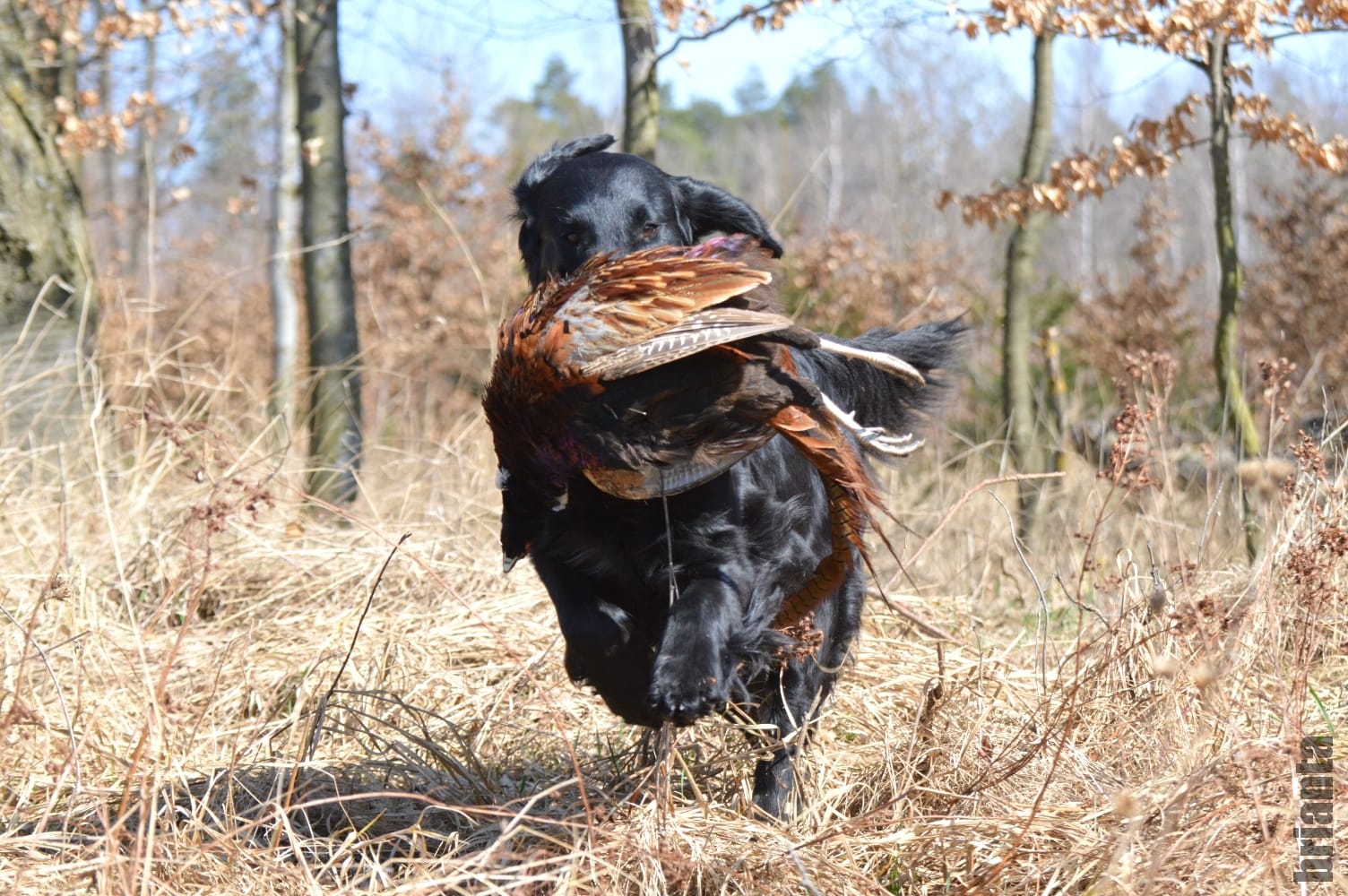
The Flat Coated Retriever is an enthusiastic and friendly dog with a strong desire to work alongside people. Equally at home in the shooting field, in a wide range of dog sports, or as part of an active family, the breed is renowned for its cheerful temperament, intelligence, and exceptional enthusiasm for retrieving and working in partnership with its handler.
A hallmark of the breed is its free-flowing, effortless and elegant movement, which reflects its balanced, athletic construction. Compared with some other retriever breeds, the Flat-Coated Retriever is often more exuberant and playful, while remaining a reliable working companion with an open, affectionate nature and a genuine love of people.



Breed Standard
A Brief History
The Flat Coated Retriever originated in Great Britain during the 19th century as a specialised gundog developed for retrieving game. The breed evolved from working retrievers that were selectively bred for reliable performance both on land and in water.
The development of the breed involved early working retrievers, together with Newfoundland dogs and setters. The aim was to produce an elegant, athletic retriever with excellent scenting ability, a soft mouth, and a strong willingness to work in partnership with its handler.
For many years, the Flat Coated Retriever was one of the most popular gundog retrievers in Great Britain. Today, it continues to be valued for its outstanding working ability while also excelling in a wide range of dog sports and as an active family companion.

Breeding Requirements
| pes / fena | ||
|---|---|---|
| Ideal Height at the Withers | 58 – 61 cm / 56 – 59 cm | |
| Dentition | *Scissor bite only; teeth may be missing except for incisors and canines. | |
| Show award obtained after 12 months of age | At least two show results are required. One of them must be obtained at a Club Show or Specialty Show with the CAC title on offer (a Regional Club Show does not fulfil this requirement), organised by Retriever Club CZ or Klub chovatelů loveckých slídičů (KCHLS). The required minimum qualification is Very Good (VD) at both shows. The second qualifying show may be obtained at any International Show, National Show, Club Show, Specialty Show or Regional Club Show. | |
| Working Trials | Retriever Working Aptitude Trial (OVVR) or any hunting working trial or competition that includes a retrieving assessment.** | |
| Hip and Elbow X-ray Examination (DKK + DLK) | HD A/A to C/C** ED assessment mandatory, max. 1/1*** |
- Notes
- *The bite must be a scissors bite. M3 teeth (the third molars in the lower jaw) are not considered functional teeth and are therefore not included in the total tooth count.
- *Dogs with incomplete dentition may only be bred to a partner with complete dentition.
- **Dogs with a DKK result of A/C to C/C may only be bred to dogs with a DKK result of A/A to B/B.
- *** As of 1 September 2026, the maximum permitted ED result for breeding approval is 1/1.
Dogs that fulfilled all breeding requirements before 9. 1 September 2026 may apply for breeding approval under the previous rules until 30 October 2026.
A list of FCI Group 8 breed judges authorised to measure height at the withers and verify the bite and dentition outside the show ring for breeding approval of retrievers can be found HERE.
Recommended Health Testing for Breeding Dogs
| Annual ophthalmological examination (PRA/CAT/RD) | The examination screens for inherited eye disorders. Both planned breeding partners should be examined, including dogs that are genetically clear of prcd-PRA. |
| PL – Patellar Luxation | an examination focused on patellar (kneecap) stability; patellar luxation can affect movement, weight-bearing on the limbs, and the dog’s long-term quality of life |
| OCD – Osteochondrosis | an examination focused on developmental orthopaedic joint disorders, most commonly affecting the shoulders; OCD can cause pain, lameness, and restricted movement |
Recommended Genetic Tests for Breeding Dogs
| It is best to consult the breed advisor. |
- Laboratories Offering Genetic Testing
- Tilila Laboratories CZ, www.tilialaboratories.cz
- Genomia (CZ), http://www.genomia.cz, sleva pro registrované chovatelské kluby 10 % https://www.genomia.cz/cz/homepage/clubs/
- Laboklin/Labogen (DE, pobočka v CZ), http://www.labogen.cz
If one parent is a carrier, the other parent must test clear (N/N) for the same mutation.
Guidelines for the Use of Genetic Testing

The correct use of genetic testing is essential. It is important to understand that a carrier is, first and foremost, a healthy dog. Thanks to genetic testing, carriers can be safely used in breeding without the risk of producing affected puppies, provided they are mated to genetically clear partners. Excluding carriers from breeding unnecessarily and significantly reduces the breed’s genetic diversity.
It is therefore important to test not only stud dogs but also breeding bitches and to use the results when selecting a suitable mate. The ideal breeding partner should be as unrelated as possible, complement the bitch in both type and quality, help balance her weaknesses, and must not be a carrier of the same genetic mutation.
It is not advisable to breed exclusively from dogs that are genetically clear for all available tests. It is important to remember that genetic tests are not yet available for many inherited conditions, and unnecessarily reducing the breed’s genetic diversity may increase the prevalence of other hereditary diseases in the future.
Health Criteria for Responsible Breeding
Dogs that are not fit for breeding should be excluded from breeding, regardless of whether they meet the formal breeding requirements. A healthy dog is not defined solely by excellent hip scores and a few favourable genetic test results.
Dogs affected by diseases or conditions for which no genetic tests are available, or that may develop later in life, should not be used for breeding. This includes, in particular, epilepsy, congenital heart disease, thyroid disorders, metabolic and autoimmune diseases, severe allergies and chronic skin conditions, entropion, ectropion, osteochondritis dissecans (OCD), bilateral cranial cruciate ligament rupture, patellar luxation, spondylosis, and similar conditions.
Breeding is, above all, a long-term responsibility towards the breed, future puppies and their owners. Concealing or downplaying health problems within breeding lines contributes to their continued spread throughout the population and may result in lifelong health problems for future generations, placing a significant burden on their owners. Every puppy that is born will share many years of life with its family. Breeders therefore have an ethical responsibility to give every puppy the best possible chance of a healthy and fulfilling life. Openness, honesty and a critical, responsible approach to the selection of breeding dogs are the foundation of responsible breeding.


How to Qualify Your Dog for Breeding

① splňte podmínky
- věk min. 18 měsíců
- výstavy
- zkoušky
- RTG
② připravte doklady
- PP originál + kopie
- 2× posudek
- zkoušky/OVVR
- RTG
- fotky
③ odešlete poradci
- doklady doporučeně
- PP k zápisu
- registrace klubem
- zápis ČMKJ
Obecné informace
- uchovnění jedince v Retriever klubu CZ je možné od věku 18 měsíců po splnění všech chovných podmínek
- členové klubu hradí poplatek za uchovnění 100 Kč na účet 2900706251/2010
- nečlenové hradí poplatek 3000 Kč
- členství lze vyřídit online přihláškou
Výstavní podmínky
- pro chovnost jsou platné posudky získané po 1 roce věku psa/feny
- minimálně dvě výstavy, z toho:
- alespoň jedna klubová (RK CZ, KCHLS) se zadáním CAC
- druhá může být mezinárodní, národní, klubová, speciální, oblastní klubová
- ocenění min. 2× alespoň velmi dobrý
- k uchovnění je potřeba doložit výšku, skus a chrup od k tomu určeného rozhodčího zaznamenané buď v posudku z výstavy nebo v PP psa
Zkoušky
- podmínkou chovnosti je absolvování:
- OVVR
- nebo zkoušek s přezkoušením přinášení
- platí klubové zkoušky RK CZ/KCHLS a zkoušky lovecké upotřebitelnosti ČMMJ (PZ – podzimní zkoušky, LZ – lesní zkoušky, ZVP – zkoušky vodních prací, VZ – všestranné zkoušky)
RTG kyčlí a loktů
- vyšetření lze provést od 12 měsíců věku u smluvního posuzovatele RK CZ
- postup:
- vyplnit formuláře DKK a DLK
- 2× vytisknout klubové certifikáty (někteří posuzovatelé si je vytisknou sami s vyplněnými údaji psa – doporučujeme se informovat)
- RTG provede veterinář (nebo posuzovatel)
- (snímky odešle posuzovateli – pokud jím sám není)
- obdržíte certifikáty
- snímkování s vyhodnocením lze provést pouze jednou
- doporučujeme předem ověřit cenu vyšetření
Doklady k uchovnění
- originál průkazu původu a kopie
- originály výstavních posudků (min. 2) a kopie
- tabulka ze svodu loveckých psů (pokud absolvován)
- tabulka ze zkoušek / OVVR
- kopie výsledků DKK a DLK + klubové certifikáty
- doklad o zaplacení členského příspěvku / členská průkazka
- dvě fotografie psa/feny (hlava a postoj) – e-mailem poradci
- doklad o zaplacení poplatku za uchovnění
Postup
- Po splnění všech podmínek zašlete potřebné doklady doporučeně příslušnému poradci chovu, který provede registraci chovnosti a záznam do průkazu původu.
- Po registraci klubem provede záznam chovnosti také Plemenná kniha ČMKJ.
- Originál průkazu původu je nutné zaslat na ČMKJ:
- u psů ihned po registraci klubem
- u fen spolu s přihláškou k zápisu vrhu
- Originály dokladů se vracejí doporučeně majiteli.
Seznam smluvních posuzovatelů DKK a DLK pro RK CZ
smluvní posuzovatel DKK a DLK pro RK CZ
MVDr. Libor Vlček
Otavská 1453
370 11 České Budějovice
smluvní posuzovatel DKK a DLK pro RK CZ
MVDr. Lukáš Duchek
K Hájům 2671
155 00 Praha 13-Stodůlky
smluvní posuzovatel DKK a DLK pro RK CZ
MVDr. Marek Pepřík
Nádražní okruh 35
746 01 Opava
smluvní posuzovatel DKK a DLK pro RK CZ
MVDr. Milan Decker
Krchleby 44
345 61 Staňkov
smluvní posuzovatel DKK a DLK pro RK CZ
MVDr. Milan Snášil
Podveská 20
624 00 Brno – Komín
smluvní posuzovatel DKK a DLK pro RK CZ
MVDr. Vilma Hypská
Medkova 1723/6
500 02 Hradec Králové
Klubový certifikát DKK a DLK ke stažení zde